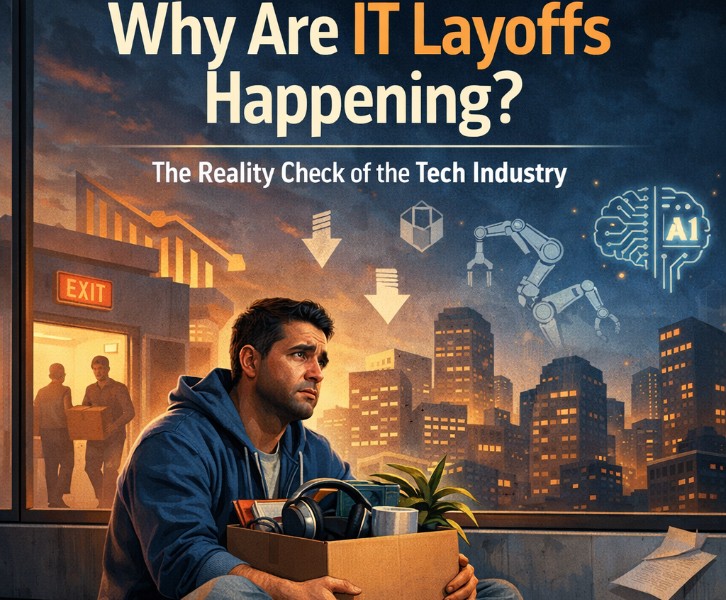
On a Tuesday morning in November, Aram opened his laptop like he had for the past seven years. Same coffee. Same Slack notifications. Same half-finished Jira ticket.
But this time, there was an email waiting for him.
“Due to restructuring…”
He didn’t read past the first paragraph. He didn’t need to.
By noon, his badge stopped working. By evening, LinkedIn was full of posts that sounded exactly like his: “Grateful for the journey…” “Open to new opportunities…” “This isn’t goodbye, just see you later…”
Everyone kept asking the same question:
Why is IT suddenly laying people off?
To answer that, you have to go back five years.
Act I: The Gold Rush
In 2020, the world locked itself indoors. Offices closed. Stores shut. Schools went online. And suddenly, software became oxygen.
Companies panicked — and then they hired.
They hired developers, testers, analysts, product managers, and cloud engineers. Not because they needed them that day, but because they were afraid they’d need them tomorrow and wouldn’t be able to find them.
Money was cheap. Interest rates were low. Investors were generous. Growth was the religion.
Executives didn’t ask, “Are we profitable?”
They asked, “How fast can we scale?”
And so headcounts exploded. Teams were built for futures that hadn’t arrived yet.
Act II: The Weather Changes
Then, quietly, the wind shifted.
Inflation rose. Interest rates followed. Suddenly, borrowing money felt like borrowing fire instead of water.
Investors changed their language:
From “How many users?”
To “How much profit?”
Budgets tightened. Marketing slowed. Expansion plans were shelved. And leaders looked at spreadsheets that no longer matched reality.
They saw teams built for ten million users serving five million.
They saw projects built for tomorrow eating money today.
And the hardest truth appeared:
People are the biggest cost.
So companies did what companies do when survival mode kicks in — they cut.
Not because employees failed.
But because forecasts failed.
Act III: The Machines Learn to Work
At the same time, another quiet shift happened.
AI began doing small things:
Writing test cases.
Monitoring logs.
Answering support tickets.
Reviewing code.
Not perfectly. Not magically.
But enough to change math.
What once took five engineers now took three and a tool.
No announcement said “You’re replaced by AI.”
But the hiring manager thought it.
And so the new rule became:
Do more with fewer people.
Act IV: The Skill Earthquake
When Aram started job hunting, he noticed something strange.
Jobs still existed — just not for what he used to do.
Companies wanted:
-
Cloud engineers
-
Cybersecurity specialists
-
Data and AI engineers
-
DevOps and platform teams
They didn’t want:
-
Large manual QA teams
-
bloated middle management
-
people who only knew one narrow tool
The market wasn’t shrinking.
It was shifting.
Like an earthquake under the ocean floor, it didn’t destroy everything — it changed where the waves landed.
Act V: What Layoffs Really Mean
Layoffs sound like failure.
But what they really mean is correction.
Tech didn’t collapse.
It sobered up.
From:
“Hire now, think later.”
To:
“Prove value or pause.”
From:
“Growth at any cost.”
To:
“Sustainable growth.”
From:
“Everyone codes.”
To:
“Only what matters gets built.”
Epilogue: The New IT World
Three months later, Aram found another job. Smaller company. Smaller team. Bigger responsibility.
No fancy cafeteria. No unlimited swag.
But real work. Real impact.
He realized something important:
The IT industry didn’t run out of work.
It ran out of illusions.
The illusion that demand only goes up.
The illusion that money is free.
The illusion that every idea deserves a team of fifty.
What remains is quieter — but stronger.
Software still runs banks.
IT still powers hospitals.
Data still drives decisions.
Security still guards everything.
The lights didn’t go off.
They were just dimmed… so companies could see what truly matters.